

Old houses are risky, but there’s no way that a new-construction house could have a radon problem, right? Nope. Although it’s a common misconception, the age of a home has nothing to do with whether or not radon is seeping up into the living spaces. In fact, some older homes might be safer because construction isn’t as tight as a new house.
Radon occurs naturally in the soil. It doesn’t really matter when a house was built. What matters is how and where it was built. While some parts of the country are more susceptible, a radon inspection helps your customers know exactly what they’re getting into. It’s a smart idea.
Is Radon Gas Really That Dangerous?
Radon gas can cause lung cancer. That’s according to the Environmental Protection Agency and it’s reason enough to worry about it. For smokers, the radon-related cancer risk is inordinately high. But for non-smokers, it’s the leading cause of lung cancer deaths, says the National Conference of State Legislators (NCSL).
The fact that radon is colorless and odorless makes it a bit scarier. How could any homeowner know if radon is there unless they test for it? They can’t. It’s a radioactive gas that’s a natural byproduct of decomposition in the soil.
As uranium decays, radon is the natural byproduct. It’s typically found in “igneous rock and soil,” says Radon.com, and can also be found in well water. People can inadvertently consume radon or breathe it. If it’s in the water, it’s safe to assume that the homeowners have ingested radon. If it’s in the air, they’ve breathed it.
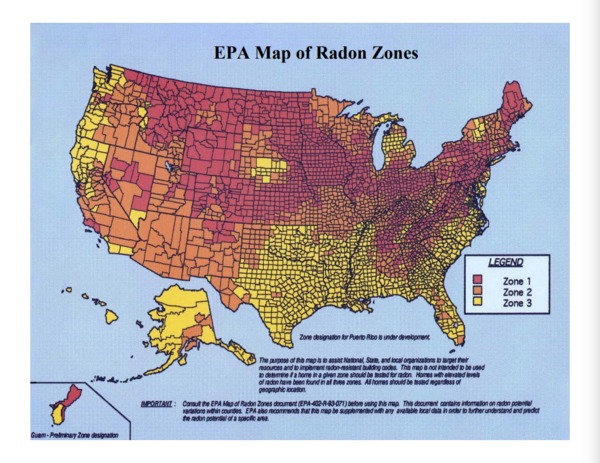
The EPA Radon Zone Map gives you an overview of radon concentrations; local governments have more information for your area.
Is Radon More Common in Certain Parts of the Country?
It doesn’t matter where you live, radon might be a problem. The NCSL says radon is present in all 50 states. That said, some parts of the country have a much higher concentration. North Dakota and Iowa, they explain, have very high levels of radon gas.
The EPA has divided the United States into three radon zones.
- Zone 1: represented in red on the map, Zone 1 has the highest potential for radon gas
- Zone 2: represented in orange, Zone 2 has moderate potential for radon gas
- Zone 3: represented in yellow, Zone 3 has a lower potential
Although zones tend to be concentrated, you’ll notice on the map that a higher or lower risk zone can pop up anywhere. Middle Tennessee, for example, is Zone 1. Western Tennessee is Zone 3. While much of the Pacific Northwest is Zone 3, there’s a Zone 1 pocket in the middle.

Radon “igloos” create a network of channels that route gas through the foundation before the house is built.
What Happens if Testing Reveals Radon?
While radon isn’t healthy for anyone, it’s not necessarily a reason to run for the hills or back out of a purchase contract. It doesn’t ‘total’ a house with repairs outweighing the value of the home. According to Rutgers University, the average mitigation system costs between $800 and $1,200 installed.
It’s not cheap, but it’s also not unattainable. That’s because it’s a lot simpler than you might think. In many cases, the equipment is so simple it’s found on the shelf at your local big box home improvement center.
Radon mitigation involves routing the gas outside the home before it can creep into living spaces. That’s all there is to it, although the technique used varies depending on the way the house was built. There may be fans and pumps involved, and there’s usually a pipe to carry gases away. If radon is detected in the soil, mitigation might be built into the foundation so that it’s never a problem, for homeowners.
Should every home inspection include radon? Probably. Radon testing equipment usually needs a few days to collect a valuable sample. You might set up the equipment on the day of the inspection and come back later to take it down. Or you could set it up in advance and take it down when you inspect the house.
Radon testing isn’t expensive for a homeowner or buyer and it’s also a nice way to supplement your income. More than that, every home is at risk of radon gas. It’s not about when a house was built but what’s in the soil under it. No matter where you live, testing could save lives.
If you’re looking for a home inspection reporting app that handles general home inspections and ancillary inspections such as radon, Report Form Pro has what you need. It’s simple, customizable and gives your customers a clean and professional-looking report. Download home inspection app for Android or get it for your iPhone or iPad at the App Store.